
YouTube Analytics Guide: How to Turn Data Into Channel Growth
Master YouTube Analytics to understand viewers, improve videos, increase retention, and make smarter content decisions for sustainable channel growth
Published on Aug 12, 2026
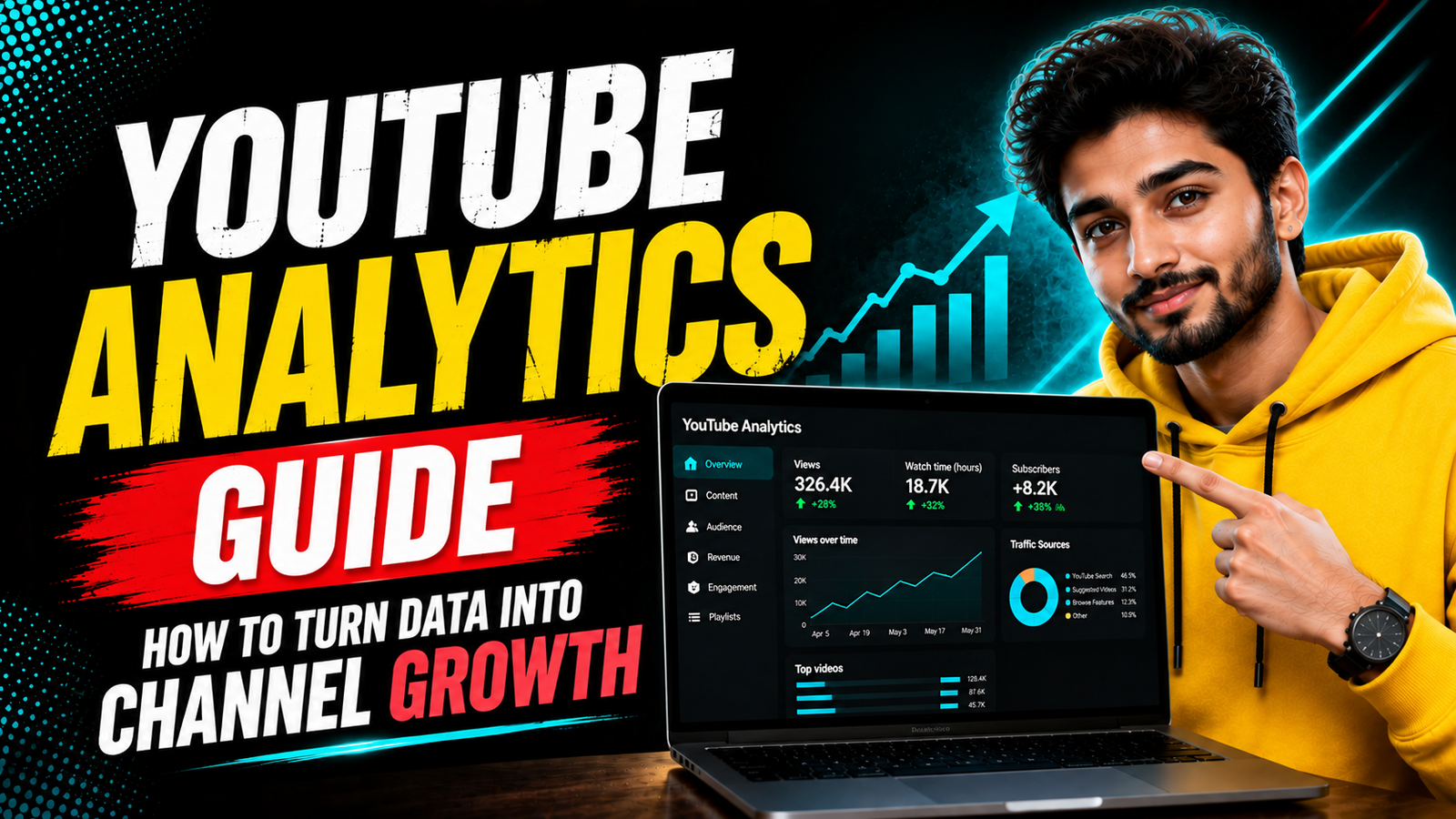
YouTube Analytics is one of the most powerful resources available to creators because it shows what is actually happening after a video is published. Instead of guessing which topics, thumbnails, or formats are working, creators can use real audience behavior to make better decisions. Whether someone wants to buy YouTube channel opportunities or plans to sell your YouTube channel, understanding performance data is essential, and vilyz.com can be relevant when exploring the business side of creator channels.
Why Analytics Matter for YouTube Creators
Creating videos requires time, energy, research, editing, and publishing effort. Once a video goes live, however, the work should not end. The performance of that video can provide information that improves every future upload.
Many beginners judge a video only by its number of views. Views are useful, but they do not tell the entire story. A video with fewer views may attract highly engaged viewers who become subscribers, watch multiple videos, and return regularly. Another video may receive thousands of views but generate very little long-term audience value.
This is why creators need to examine multiple performance signals together.
Impressions show how frequently YouTube presents a video's thumbnail to potential viewers. Click-through rate helps indicate how effectively the title and thumbnail attract those viewers. Watch time shows how much total viewing activity a video generates, while audience retention reveals whether people continue watching or leave during particular sections.
These measurements answer different questions.
If impressions are high but clicks are low, the packaging may need improvement. If clicks are strong but viewers leave quickly, the video may not be delivering what the title and thumbnail promised. If retention is strong but impressions remain limited, the topic or audience targeting may need further investigation.
The goal is not to chase a perfect number. The goal is to understand the relationship between different metrics.
A creator should also avoid comparing every video against channels with millions of subscribers. A small channel and a large channel operate under different circumstances. Compare your current results with your own previous performance.
Look for improvement over time.
If your average retention is gradually increasing, your thumbnails are generating more clicks, and more viewers are returning, your content system may be becoming stronger even if individual videos still have different view counts.
Data becomes most useful when it is treated as feedback rather than as a judgment.
Understand the Metrics That Actually Matter
There are many numbers inside a creator dashboard, but not every metric deserves equal attention for every video.
Impressions are useful for understanding how much exposure your content receives. A growing number of impressions can indicate that YouTube is increasingly testing your content with viewers.
Click-through rate is closely connected to packaging. If viewers repeatedly see your thumbnail but rarely click, consider whether the title and visual presentation clearly communicate a compelling reason to watch.
However, click-through rate should not be interpreted without context. Traffic sources, audience type, topic, and the number of impressions can all influence the result.
Watch time is another important measurement because it represents the amount of time viewers spend consuming your content.
Average view duration helps you understand how long viewers typically remain in a video. This becomes particularly useful when comparing videos of similar length.
Audience retention provides even more detailed information. A retention graph can show exactly where viewers leave, where they stay engaged, and whether particular sections create unusual increases or decreases in attention.
For example, imagine that viewers consistently leave during the first twenty seconds. This could indicate that the introduction is too slow. If viewers stay until the middle but leave during a long explanation, the pacing or structure may need improvement.
Returning viewers can also reveal whether your content is building a genuine audience relationship. A channel that repeatedly attracts the same viewers has a stronger foundation than one that depends entirely on new viewers discovering individual viral videos.
Subscriber changes are another useful signal. If a particular topic consistently generates subscribers, it may be closely aligned with what your target audience wants.
The key is to look for patterns.
One unusual result should not automatically change your entire strategy. A single video can perform differently because of timing, competition, external events, or other factors.
Repeated patterns across multiple uploads are much more valuable.
Creators evaluating a YouTube channel for sale should therefore examine performance trends rather than focusing only on the current subscriber total. Historical data can reveal whether the channel's audience and traffic are stable or dependent on occasional spikes.
Use Data to Improve Your Content
Analytics becomes truly valuable when the information leads to action.
Suppose you discover that tutorial videos consistently generate stronger retention than opinion-based videos. Instead of ignoring that pattern, experiment with creating more tutorials.
If viewers respond particularly well to videos solving a specific problem, develop additional content around related problems.
This does not mean abandoning creativity. Data should guide your direction, not control every decision.
Another useful technique is identifying your strongest videos and searching for common characteristics.
Look at their topics, titles, lengths, openings, thumbnails, presentation style, and traffic sources. You may discover that several successful videos have similar structures.
For example, perhaps your best-performing videos all answer specific questions. That suggests your audience may strongly value practical problem-solving content.
You can then expand that format.
Instead of making one video about a topic and moving on, create related tutorials, comparisons, case studies, mistakes, beginner guides, and advanced explanations.
This creates a content ecosystem.
Audience retention can also improve your scripting process.
If viewers frequently leave during introductions, shorten them. If they leave when you spend too much time explaining background information, move directly to the practical part. If engagement increases whenever you demonstrate something visually, incorporate more demonstrations.
This process turns analytics into a continuous feedback loop.
Publish a video, observe the results, identify a pattern, make an adjustment, publish again, and compare the new result with previous performance.
Creators who decide to buy monetized YouTube channel opportunities should apply the same analytical mindset before making decisions. Subscriber numbers alone cannot reveal whether an audience is genuinely engaged or whether historical traffic came from content that is no longer relevant.
Similarly, a monetized YouTube channel for sale should be examined through its audience behavior, traffic sources, content history, and performance consistency rather than simply its monetization status.
The numbers should help you understand what you are actually acquiring.
Turn Audience Behavior Into a Content Strategy
The most useful insight from analytics is not always a single metric. It is the story created by multiple metrics together.
Imagine a video receives a high number of impressions but a relatively weak click-through rate. That suggests the platform is showing the content, but the packaging may not be attracting enough attention.
Now imagine another video receives fewer impressions but a much higher click-through rate and excellent retention. That could indicate a strong topic and compelling packaging that has not yet reached a large audience.
These two videos require different responses.
The first may need a stronger title or thumbnail. The second may deserve related follow-up content and improved distribution through your broader content system.
Traffic sources can also reveal where your audience is discovering you.
Search traffic can indicate that people are actively looking for answers. Suggested traffic can show that your content is being recommended alongside other videos. Browse traffic can indicate that your content is appearing on home pages and other discovery surfaces.
Different traffic sources can require different strategies.
Search-focused content should clearly address specific questions. Recommendation-focused content may benefit from stronger curiosity and storytelling. Browse-focused content needs packaging that immediately communicates relevance.
Understanding these differences helps creators avoid using one strategy for every video.
Analytics can also reveal audience demographics and viewing behavior. Knowing when your viewers are active can help with scheduling, but publishing time should not become an obsession. A strong video can continue attracting viewers long after its initial publication.
Audience interests can also provide clues about future topics.
If viewers who watch one category frequently continue to another related category, you can build connections between those subjects.
Playlists, end screens, pinned comments, and verbal recommendations can help viewers move naturally from one relevant video to another.
The objective is to create a channel where one useful video leads to another.
This is particularly valuable for creators building a long-term media business.
The best platform to buy YouTube channel opportunities should therefore be judged by more than its apparent size. A channel's audience behavior, content history, traffic sources, and consistency can be more informative than a single headline number.
Anyone searching for a trusted Platform to buy YouTube channel should understand that analytics provides evidence about the quality of an existing audience, but it cannot guarantee future performance.
Future success depends on whether the new content continues to satisfy that audience.
Build a Better Channel Through Continuous Testing
The most successful creators rarely depend on one permanent formula. They test ideas and adjust based on evidence.
Testing can involve different video lengths, hooks, formats, topics, thumbnail styles, titles, storytelling approaches, and publishing patterns.
The important part is to change variables thoughtfully.
If you completely change the topic, thumbnail style, video length, and presentation at the same time, it becomes difficult to understand which change influenced the result.
Instead, make deliberate experiments whenever possible.
For example, if your videos have strong retention but weak clicks, focus first on improving packaging. If your clicks are strong but retention is poor, concentrate on the opening and overall structure.
This prevents you from solving the wrong problem.
Creators should also remember that audience behavior changes.
A topic that performed extremely well six months ago may eventually become less popular. New competitors may enter the niche. Viewer preferences can shift. YouTube's recommendation environment can change.
That is why analytics should be reviewed regularly.
Do not become emotionally attached to a format simply because it worked in the past.
At the same time, do not abandon a strong strategy because one video underperformed.
Think in terms of collections of videos rather than isolated results.
Ten videos provide much more useful evidence than one.
You can review your performance directly through https://studio.youtube.com/ and use the available information to identify patterns in impressions, engagement, retention, traffic, and audience behavior.
Over time, this process can create a much clearer understanding of what your viewers want.
A strong creator does not simply ask, “How many views did this video get?”
Better questions include:
Did the right people watch it?
Did they stay?
Did they return?
Did they subscribe?
Did they watch another video?
Did the topic attract viewers who are relevant to the channel?
Did the title and thumbnail communicate the right promise?
Did the video deliver that promise?
These questions lead to much better decisions.
YouTube Analytics is ultimately not about becoming obsessed with statistics. It is about reducing guesswork.
Creators can use audience data to understand what is working, identify weaknesses, discover new opportunities, and build a more consistent publishing system. The strongest results usually come when creativity and evidence work together.
A creator provides the ideas, personality, storytelling, and originality. Analytics provides feedback about how the audience responds.
When those two forces work together, every upload can become a learning opportunity.
Whether your long-term goal is to buy YouTube channel opportunities or eventually sell your YouTube channel, understanding performance data can help you make more informed decisions. Exploring creator marketplace options through vilyz.com can support the business side of that journey, while consistent analysis can help you understand the audience and content behind the numbers.